Every small business owner has heard it by now. AI is coming, AI is changing everything, AI is the future. And most of them are nodding along in meetings while quietly wondering the same thing: okay, but where do I actually begin?
That gap between knowing you need to do something and knowing what to do first is exactly where most businesses get stuck. Not because they lack ambition or resources, but because the conversation around AI has been built around large enterprises with dedicated technology teams. If you are running a 20 person company, a regional service business, or a growing operation without a CIO, the advice rarely feels like it was written for you.
The good news is that starting with AI does not require a massive budget, a data science team, or a six month transformation project. It requires three things done in the right order.
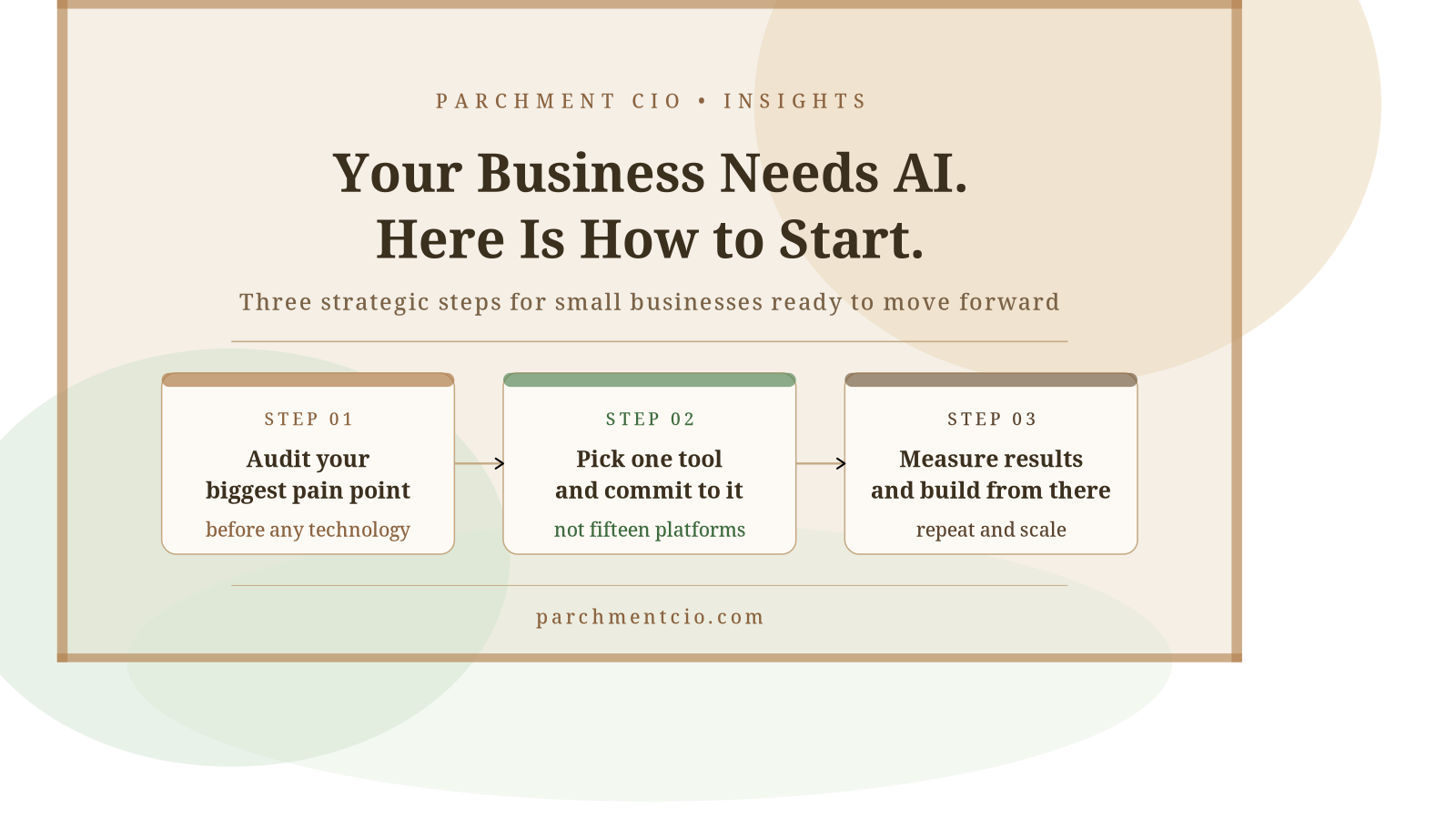
Step 1: Audit your biggest pain point before you touch any technology
Before you look at a single AI tool, spend time identifying the one area of your business that costs you the most time, creates the most errors, or slows your team down the most consistently. Not the flashiest problem. The most painful one.
This matters because AI tools are not general solutions. They are specific solutions applied to specific problems. A business that jumps straight to buying software without doing this audit almost always ends up with a tool that nobody uses because it was never connected to a real operational need.
Ask your team two questions. What task do you do every week that you wish someone else could handle? And what part of your day produces the least value for the time it takes? The answers will point you directly to where AI can make a meaningful difference fast.
Step 2: Pick one tool and commit to it
Once you know the problem, resist the urge to evaluate fifteen different platforms. That path leads to analysis paralysis and a graveyard of unused software subscriptions.
Instead, pick one tool that directly addresses the pain point you identified and give it a real trial. Real means your team uses it in actual work, not in a sandbox. Real means someone owns the implementation and checks in on it weekly. Real means you give it at least 30 to 60 days before making a judgment call.
Some of the most common starting points for small businesses right now are AI writing assistants for content and communications, AI scheduling and workflow tools for operations, and AI powered customer support for handling routine inquiries. None of these require deep technical expertise to get running. They just require focus.
Step 3: Measure what changed and build from there
After your first tool has been running for a month or two, take stock. Did it actually reduce the time spent on the problem you targeted? Did it free up capacity that got redirected somewhere useful? Did your team adopt it or quietly go back to the old way?
This step is where most small businesses skip ahead too fast. They feel momentum and immediately start adding more tools before the first one has proven its value. That creates complexity without clarity, and it makes it very hard to know what is actually working.
One successful implementation gives you something more valuable than another tool. It gives you a template. You now know how to identify a problem, evaluate a solution, deploy it, and measure the outcome. That process scales. Repeat it with the next pain point, then the next. Over 12 months you will have built a functioning AI strategy from the ground up, without ever needing to boil the ocean.
The businesses that will get the most out of AI in the next few years are not the ones who move the fastest. They are the ones who move with intention. Start with a real problem, solve it with a focused tool, prove the value, and build from there.
If you are ready to take the next step, book a strategy session and we can work through it together.